August 27, 2026 · GRAFOLIO
Factor Rotation — Regime-Aware Systematic Portfolio
Factor Rotation — Regime-Aware Systematic Portfolio
Executive Summary
A systematic factor rotation strategy that combines two independent regime signals — one, that is slow-moving & lagged and the other more latent derived micro-structure signal that is contemporaneous — to dynamically allocate across 9 uncorrelated factor ETFs. The ensemble achieves 2.6× SPY's Sharpe ratio with less than one-third the drawdown of SPY over a 10-year out-of-sample period.
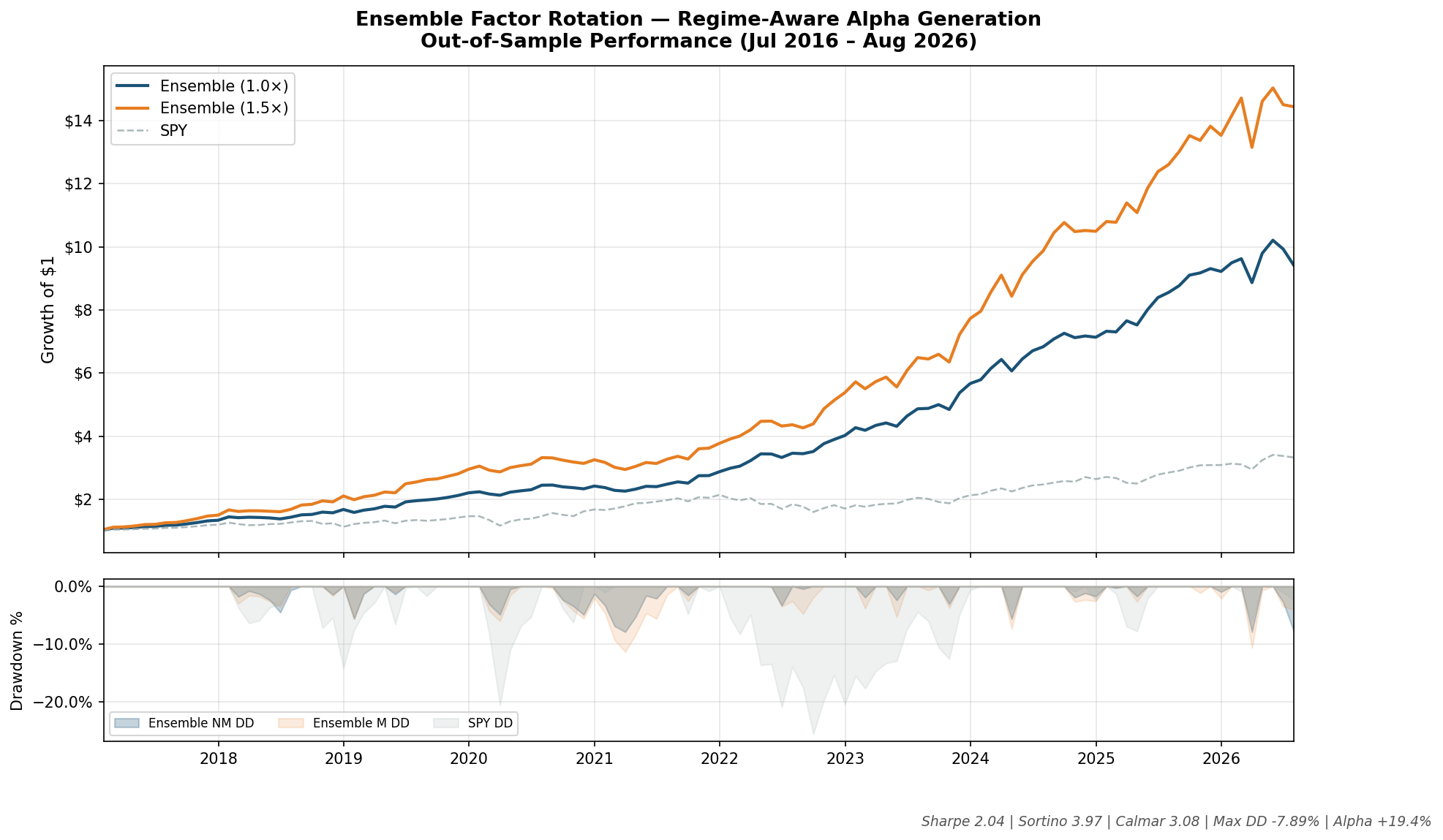
Performance (Jul 2016 – Aug 2026)
| Metric | Ensemble (1.0×) | SPY |
|---|---|---|
| CAGR | +24.32% | +14.01% |
| Sharpe | 2.04 | 0.90 |
| Sortino | 3.97 | 1.26 |
| Calmar | 3.08 | 0.55 |
| Max DD | -7.89% | -25.48% |
| Alpha (CAPM) | +19.43% | — |
| Beta vs SPY | 0.35 | 1.00 |
| Rebalances | 42/115 | |
| Avg Turnover | 0.26 |
Growth of $1 (with drawdown):
How It Works
1. Dual-Signal Regime Detection
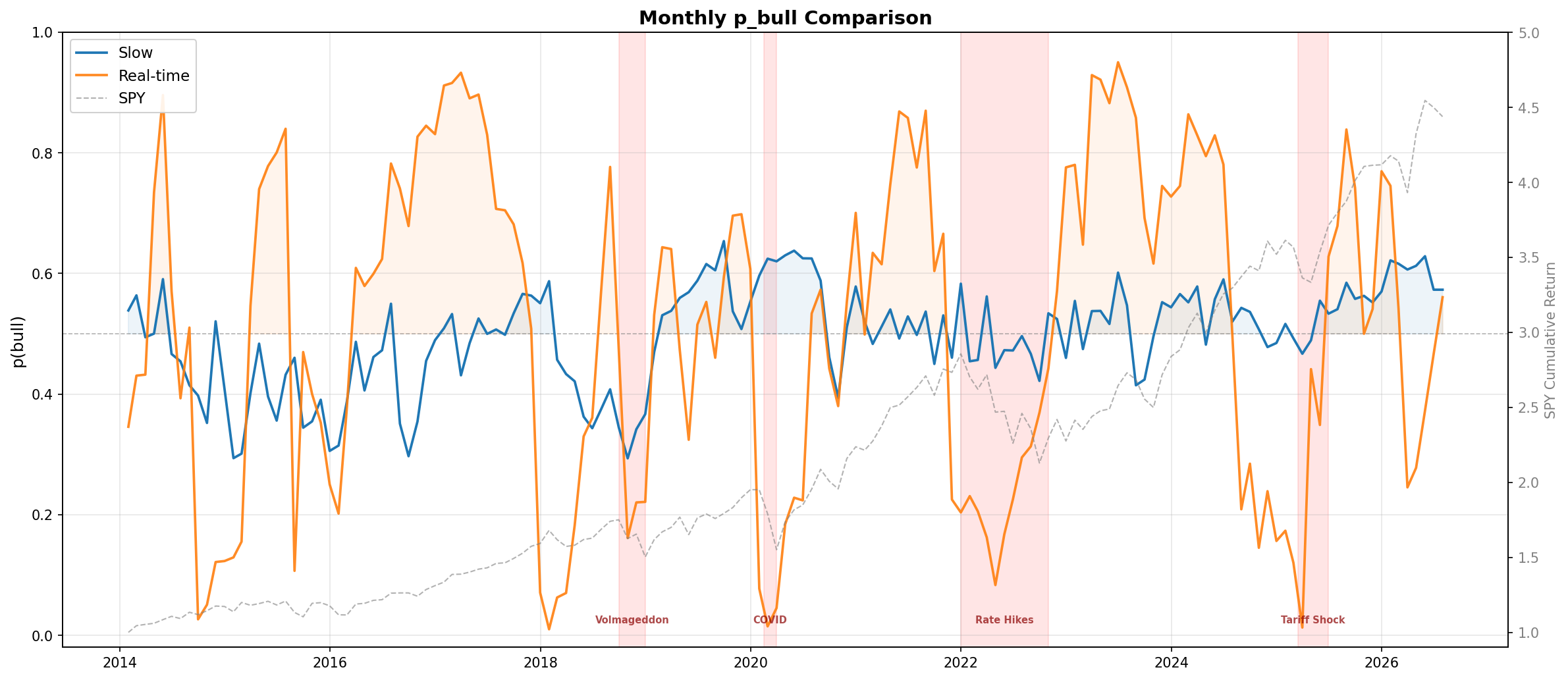
Two independent signals identify market regime with no look-ahead bias:
-
Slow — Lagged smoothed signal processed through a Gaussian Process + Dirichlet Process mixture. Detects macro regime shifts (expansionary vs contractionary).
-
Real-Time — Latent variable derived from SPX prices detects stress before (in theory) it propagates to broader markets.
The two signals are near-independent (correlation 0.15), providing complementary coverage: One catches slow-moving liquidity cycles, while the other catches fast-moving stress events.
2. Factor Rotation via Bayesian Optimization
Monthly allocation across 9 uncorrelated factor ETFs:
| Factor | Role |
|---|---|
| Momentum | Equity trend |
| Min Volatility | Defensive equity |
| Intermediate Bonds | Rate hedge |
| Gold | Inflation hedge |
| Quality | Quality tilt |
| Commodities | Real assets |
| Managed Futures | Trend following |
| (2× SPY) | Leveraged equity |
| (-1× SPY) | Short equity |
The Bayesian optimizer maximizes risk-adjusted returns while penalizing turnover. The regime signal modulates risk aversion in real-time — when stress is detected, the optimizer naturally reduces exposure to risky factors.
3. Downside Protection
During stress periods, the strategy's risk aversion parameter increases by 2.5×, causing the optimizer to shift toward defensive factors (low-vol, bonds, gold) without explicit override rules. This is thus more structural protection, than tactical timing.
Transaction Costs
| Component | Estimate |
|---|---|
| Average monthly turnover | 33.66% |
| One-way cost (bid-ask + impact) | 5–10 bps |
| Annual cost drag | 0.20%–0.40% |
| Sharpe impact | 2.04 → 2.01 |
The strategy trades liquid, highly-quoted ETFs with tight spreads. Transaction costs reduce Sharpe by approximately 3bps..
The optimizer includes a built-in turnover penalty that limits unnecessary trading. Rebalancing occurs only when weight changes exceed 5%.
Key Takeaways
- Superior risk-adjusted returns: Sharpe 2.04 vs SPY 0.90 (2.6× improvement)
- Structural downside protection: Max DD -7.89% vs SPY -25.48%
- Regime-aware allocation: Automatically reduces exposure during microstructure stress
- Low cost drag: Transaction costs reduce Sharpe by only 0.03
- Fully systematic: No discretionary decisions, no parameter overfitting
Important Disclosures
- Out-of-sample results: All performance shown is out-of-sample (Jul 2016 – Aug 2026). In-sample training period used for model calibration only.
- No guarantees: Past performance does not guarantee future results.
- Model risk: Regime detection models may produce false signals. Strategy relies on two independent signals to mitigate this risk.
- Leverage risk: The strategy uses leveraged ETFs (SSO) which carry additional risks including decay in choppy markets.